
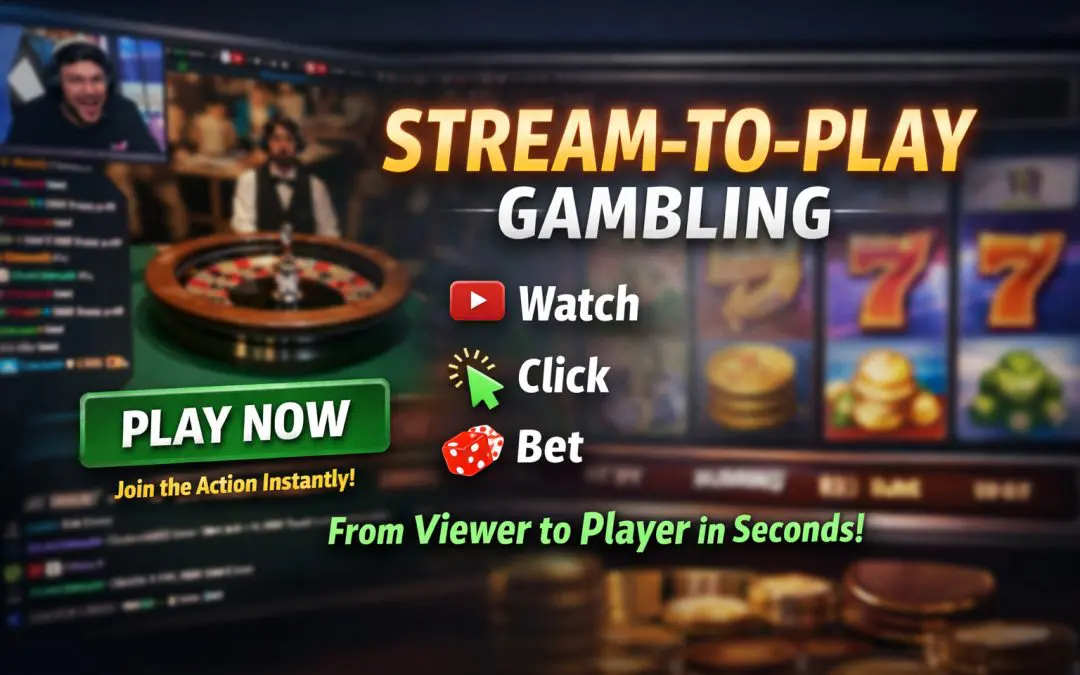
Stream-to-play links represent a complete and seamless transition from a gambling livestream to an active bet. For the first time ever, consumers can now view a professional gambler’s activity while actively participating in the very same action; essentially creating an immersive experience.
Before, viewing a live gambling stream typically resulted in little more than being entertained by a person playing video poker or roulette. There would be little to no chance of the viewer signing up for the same online gaming platform.
As gambling livestreams evolved, the space began to see an explosion of revenue-generating opportunities. The ability to seamlessly convert a viewer into a player within the confines of the stream provided operators with the ultimate tool to generate revenue. This ultimately led to the creation of ‘stream-to-play’ affiliate programs.
In essence, stream-to-play affiliate programs provide an integrated platform for both the consumer and the operator. Operators can now track and monitor all aspects of the viewer-to-player process. Consumers can now engage in a more personal way with the content they are consuming.
Gambling livestreams have been evolving for several years. Prior to recent advancements in software and technology, the vast majority of gambling livestreams existed solely as entertainment. While entertaining, these livestreams rarely converted viewers into players. However, due to innovations such as WebRTC (real time communication), the development of streamlined Mobile registration processes, geolocation targeting capabilities and the overall growth of digital gaming platforms, gambling livestreams are rapidly becoming an important marketing channel for digital gaming operators.
While there are certainly similarities between Kick and Twitch in regards to gambling livestreams, there are significant differences between how these two platforms interact with their respective communities.
Kick, which has largely become a haven for live casino streaming, provides its community with an atmosphere that is generally more relaxed than Twitch. As a result of this relaxed atmosphere, Kick has become known for allowing live casino content creators to operate in a manner that is significantly more flexible than Twitch.
This flexibility allows live casino content creators to develop strong relationships with their audience, thus promoting the brands they work with. Additionally, this flexibility provides live casino content creators with a greater degree of control over their affiliate marketing efforts.
This type of control enables live casino content creators to tailor their affiliate marketing efforts to meet the needs of their individual audiences. This type of targeted marketing is far superior to non-targeted affiliate marketing efforts.
one major advantage Twitch has over Kick is its large-scale moderation system. While Twitch’s moderation system has undoubtedly contributed to Twitch being a safe and family-friendly platform for most types of content, it has also served as a barrier for live casino content creators looking to grow their audiences.
Moderation policies on Twitch limit the types of promotions live casino content creators can make to their audiences. These limitations make it difficult for live casino content creators to promote their favorite games and casinos in the same way as content creators who produce content unrelated to gambling.
As a result, many live casino content creators have found themselves migrating to Kick. Kick provides a more relaxed environment for live casino content creators to build their audiences. With moderation policies that are generally more lenient than Twitch’s policies, live casino content creators on Kick have a greater degree of freedom to create promotional material for their favorite games and casinos.
Another advantage Twitch has over Kick is its larger scale. Twitch has significantly more users than Kick. As a result, live casino content creators who choose to host their content on Twitch are able to reach a much wider audience than they would on Kick.
However, this larger scale comes at a cost. Due to Twitch’s strict moderation policies regarding promotions related to gambling, many live casino content creators find themselves having difficulty reaching their full potential. As previously mentioned, Twitch’s moderation policies prevent live casino content creators from making certain types of promotional statements about the games and casinos they love.
These policies serve as barriers for many live casino content creators. Instead of building strong relationships with their audiences and developing long-term strategies to increase engagement and drive conversions, many live casino content creators find themselves focusing solely on generating short-term revenue through ad-supported streaming models.
As we discussed earlier, these types of streaming models provide little to no financial incentive for live casino content creators. To overcome these issues, many live casino content creators have turned to Kick.
While Kick lacks Twitch’s large-scale user base, it provides live casino content creators with a more flexible environment to build their audiences and create promotional materials that reflect their values. By providing live casino content creators with more creative freedom and more flexible moderation policies than Twitch, Kick has positioned itself as the ideal platform for live casino content creators who seek to build loyal audiences and develop long-term strategies to increase engagement and drive conversions.
To date, Twitch remains the largest platform for live casino streaming. Despite its large-scale user base and established reputation among gamers and esports enthusiasts, Twitch continues to struggle to attract and retain live casino content creators.
Due in large part to Twitch’s restrictive moderation policies and lack of emphasis on providing live casino content creators with financial incentives and creative freedom, many live casino content creators have chosen to migrate to alternative platforms.
Platforms such as Kick have filled this void by providing live casino content creators with more flexible environments to build their audiences and create promotional materials that reflect their values.
By positioning itself as the premier platform for live casino streaming and attracting high-profile talent from Twitch and other platforms, Kick is establishing itself as a viable competitor in the world of live casino streaming.
With thousands of hours of live casino streaming available across multiple platforms, it is easy for consumers to become overwhelmed by the sheer number of choices. one solution that can help alleviate this issue is by providing consumers with recommendations based on their interests and preferences.
While there are certainly many different ways in which recommendations can be made available to consumers, there are three primary types of recommendations:
1) recommendations based on past behavior;
2) recommendations based on stated preferences;
3) recommendations based on collaborative filtering techniques;
Each of these types of recommendations offers unique advantages and disadvantages for consumers and operators alike.
Recommendations based on past behavior
Recommendations based on past behavior refer to recommendations that are generated based upon an analysis of how a consumer has behaved in the past. When analyzing past behavior, operators can identify patterns that indicate which types of games or bonuses a particular consumer enjoys or responds positively to.
Using data collected during previous sessions or interactions, operators can then use this information to recommend future activities or offers that are tailored specifically to the consumer’s demonstrated interests.
one key benefit associated with using recommendations based on past behavior is increased relevance. Since these recommendations take into consideration an individual consumer’s prior actions and preferences, they provide greater relevance and accuracy compared to other forms of recommendations.
However, one downside associated with using recommendations based on past behavior is that they rely entirely upon historical data. Therefore, consumers may not receive recommendations that align with current trends or emerging markets unless they begin exhibiting behaviors consistent with those trends or markets.
Recommendations based upon stated preferences
Recommendations based upon stated preferences refer to recommendations generated based on an assessment of a consumer’s expressed desires or preferences. Operators can gather this type of information directly from consumers via surveys or indirectly through tracking devices or cookie files placed on consumers’ browsers after visiting websites.
Since these recommendations are derived directly from the consumer’s own input or expressions of preference, they naturally tend to exhibit higher levels of relevance compared to recommendations generated using historical data alone.
one disadvantage associated with relying on stated preferences is that consumers may not always accurately express their true desires or preferences. In addition, since consumers must take the initiative to share their preferences explicitly with operators in order for these preferences to be taken into account when recommending future activities or offers, there exists a potential disconnect between what consumers truly desire versus what they explicitly state they prefer.
Collaborative filtering-based recommendations
Collaborative filtering-based recommendations involve identifying groups of consumers who demonstrate similar behavior or preferences. Using complex algorithms and statistical modeling techniques, operators can analyze consumption habits across entire networks or communities of consumers.
Based upon observed patterns of similarity or correlation between various consumers or groups of consumers, operators can recommend products or services that have exhibited popularity or success among those identified as being demographically similar or possessing comparable behavioral traits.
Some benefits associated with using collaborative filtering include greater scalability and reduced dependency on explicit consumer input relative to other forms of recommendations. Collaborative filtering-based recommendations also enable operators to identify novel preferences or patterns of behavior among subsets of consumers who may otherwise remain anonymous or overlooked.
However, a primary limitation associated with using collaborative filtering includes its reliance upon extensive amounts of historical data pertaining to consumer behavior. Until sufficient numbers of data points exist regarding an individual consumer’s history of consumption habits or preferences, operators may not have enough actionable intelligence to begin making effective collaborative-filtering-based recommendations.
Additional limitations associated with all forms of recommendations
Regardless of whether operators elect to utilize recommendations based on past behavior, recommended preferences, or collaborative filtering techniques; each approach presents inherent limitations associated with varying degrees of predictive accuracy and/or potential bias toward favoring established or historically successful offerings over emerging or innovative alternatives.
Ultimately, operators must weigh these trade-offs carefully when determining which form(s) of recommendations to implement as part of their overarching strategy for driving engagement and facilitating customer acquisition within the competitive realm of online gaming.
Ultimately, operators must weigh these trade-offs carefully when determining which form(s) of recommendations to implement as part of their overarching strategy for driving engagement and facilitating customer acquisition within the competitive realm of online gaming.
The technological aspect underlying seamless wagering has progressed further than most users perceive. Users no longer want the feeling that they’re watching one moment and betting in another; instead they wish for synchronization (or at least an illusion thereof). If a streamer reacts to a card being dealt in a live-dealer table, users who are attempting to access the same table expect it will load quickly enough so that emotional link isn’t severed.
That is where streaming infrastructure plays an important role. WebRTC streaming (real time communication) lowered expectations surrounding real-time interaction far more than traditional broadcast pipeline. Practically speaking, less delay equates to more believable shared experience — thereby enabling developers with greater ease to construct gambling-related chat integrations and overlays inside streams where users aren’t experiencing severe delays from the action unfolding in real-time.
Product teams have also grown more adept at eliminating the awkward transitions that often accompany wagering. Successful architectures for seamless wagering nearly always consider factors such as:
1.) Geo-aware routing so users land on legally compliant or relevant offers in their area.
2.) pre-selected game pages matching what the streamer is playing.
3.) Mobile-first deposit flows — particularly for users who stay on Mobile exclusively throughout.
4.) fast loading speed coupled with clarity around bonus conditions so users don’t abandon.
5.) tracking capable of distinguishing between idle clicks and actual depositors.
The former point represents perhaps the greatest disparity in how successfully platforms execute their respective approaches toward seamless wagering experiences. An average mid-tier streamer employing clean paths results in significantly better performance against larger names utilizing poorly constructed affiliate linking systems.
Beyond traditional affiliate linking systems — watch-to-bet features are starting to emerge as a promising option. Examples include tying a stream panel directly into live odds, pre-selecting featured tables or session challenges; as well as implementing triggers such as chat-based prompts — offering timed promotions — or overlay-based events triggered by time-sensitive events (e.g., start/end times).
Good implementations will add contextually. Poor implementations will appear more akin to pop-ups disguised as streamer-based advertising.
Many teams struggle defining the line between excellent contextual integration vs manipulation through design.
Gambling livestreams continue to evolve at a rapid pace — albeit at varying rates depending upon the platform utilized. While Twitch appears poised to maintain its status as the dominant platform for general-purpose gaming livestreams — including esports — it faces stiff competition from Kick and other dedicated platforms focused primarily on online gaming.
Prioritizing innovation above tradition — particularly concerning its position toward supporting online gaming — has allowed Kick establish itself as a legitimate competitor in the realm of online gaming livestreams.
Through continued investment in its technology platform and hiring of high-profile talent away from Twitch — Kick solidifies its position as a viable platform for both producers and consumers seeking high-quality online gaming-focused livestreaming solutions
Real-time betting streams are revolutionizing how gamblers behave.
Traditionally, the journey of a gambler was broken down into three stages; choosing an online site, choosing a game to play, possibly looking at promotional offers, and finally settling into play. With real-time betting streams, these steps are compressed together. The viewer arrives at the site pre-warmed-up by another person’s energy; already familiar with the game on-screen; and often already primed to gamble by the comments made in chat.
This compression affects a gambler’s behavior in multiple ways:
1) session start-ups become more impulsive. The viewer has not planned his/her bankroll, selected a game, set time limits, etc. Therefore, he/she enters the session “cold”, emotionally hot.
2) game selection is reduced. Rather than browsing different games on-site, the viewer chooses the game being streamed.
3) loss perceptions may become distorted due to the streamer manipulating reality in real-time. The streamer’s reactions (positive/negative), bonus rounds, bankroll framing may cause the viewer to perceive volatility as acceptable, despite the fact it may be punishing.
These effects are very apparent in micro-betting streams and fast-paced slots. The small bet amount prompts appear to be harmless, especially when prompted repeatedly. However, the repetition is responsible for this effect. It is possible for a viewer to transition from saying “i’ll only try a few spins” to spending two hours playing slots based solely on the continuous nature of the stream. The stream appears to have no end point. The stream continues by displaying One additional feature, One additional racing event, One additional suggestion to play. This is why stream-to-play links are so successful and yet so widely criticized. Stream-to-play links don’t simply capitalize on existing demand. Stream-to-play links can create demand.
Revenue isn’t just coming from clicks
Many people misunderstand the revenue potential of stream-to-play links. People believe the primary source of revenue comes from acquiring customers directly via click-through rates. While that is significant, it is not the complete picture.
Stream-to-play links offer many benefits beyond direct sign ups such as improved retention, reactivation of inactive accounts, and increased familiarity with your brand. Static advertisements cannot accomplish these goals. A user viewing the same sponsor for consecutive weeks develops a level of comfort with that brand. The casino is no longer a generic casino logo. The casino is “the site used by [streamer]”. Soft trust builds quickly.
Additionally, Operators gain valuable insights regarding the streamer’s audience. Operators can determine which games generate surge activity within chat, when specific moments result in spike in clicks, how live deposits are affected by various promotions, and how different types of creators attract recreational players vs. Experienced/ high-value grinders. For Operators with a keen understanding of their audience, streams serve as a live test environment for products.
Lastly, streams contain a unique community aspect. Stream chat provides social proof to other viewers. When users share their own winning experiences with others, request information about finding a particular game, or compare rewards from bonus offers, the funnel becomes partially driven by peers. At this point, integrating chat into gambling is not just a formality, it is a conversion tool.
In my experience, i’ve witnessed average affiliate websites having difficulty creating urgency comparable to what can be created by a live stream within minutes. The reason for this difference is straightforward: static pages describe excitement whereas streams demonstrate it.
Regulatory challenges will only grow larger
At this point in our discussion, we typically take a turn.
The very features that allow for stream-to-play gambling to be highly profitable for commercial entities create concerns among regulators. Stream-to-play gambling combines elements of advertising, entertainment, and direct solicitation. It appeals to younger audiences and crosses borders poorly. It exposes viewers to Operators that are compliant in some jurisdictions and questionable in others. Additionally, the majority of streamers’ disclosure practices vary from fully transparent to extremely poor.
Unregulated gambling streams pose major problems because streaming platforms exist globally while gaming law does not. A streamer can have thousands of viewers from numerous countries in One chat. Depending on which country views a streamer’s link, the link itself could be lawful, restricted, or completely prohibited. Furthermore, the streaming platform itself does not consistently communicate these complexities clearly.
Another frequent issue exists surrounding sponsored account balances, bonus funds, and how creators portray risk. Viewers rarely understand if the creator is using their own money, house money, deal specific money or a combination thereof when viewing gameplay. Understanding this ambiguity creates authenticity issues related to viewing someone risking large sums of money. If a viewer believes someone is risking their own money due to the lack of clear communication surrounding the type of money being used (house money or otherwise), they may view that risk as authentic when it is actually not.
Therefore, anticipate continued scrutiny concerning several aspects including: enhanced age gating requirements; improved sponsorship disclosure; enhanced regional restrictions on linking; and enhanced regulations governing gambling promotion by streaming platforms. Some jurisdictions will permit links but prohibit overlays. Other jurisdictions may permit educational content while restricting direct calls to action.
This patchwork may get messier before becoming cleaner
As expected, the logical progression of stream-to-play is deeper integration. Additional native-looking overlays. More dashboards for creators. Enhanced landing page flows that are more customized to individual preferences. Greater synchronization between key moments in the stream and corresponding casino pages. Smarter segmentation based on geography, device usage and player value. Essentially, more systems to transform attention into action without disrupting the entertainment-based relationship between the viewer and the streamer.
However, there is a limit to this expansion.
When the stream becomes too transactional, viewers will begin to pull away. Viewers are intelligent individuals and recognize when they have developed an appreciation for a content provider who has shifted entirely towards becoming a full-time lead generation machine for acquisitions. Trust evaporates rapidly when the streamer feels like nothing more than an extended advertisement featuring infrequent gaming opportunities.
It is likely that this tension will define the next evolution of stream-to-play. Those Operators who successfully preserve viewer enjoyment while establishing seamless transitions into playing opportunities will ultimately succeed. Successful Operators will need to provide viewers with an enjoyable experience while providing them with an opportunity to engage in gaming activities that meet their interests and expectations. This approach may seem less aggressive than “optimize conversion at all costs,” however historically speaking, subtlety tends to prevail in developing engagement through entertainment-driven acquisition methods.
There is another development occurring simultaneously. Improvements in live dealer streaming technologies along with lower latency technologies are enabling greater fluidity between the stream and platform environments. Viewers may soon view content and gaming as adjacent concepts rather than distinct entities. Ultimately, this may render the concept of stream-to-play links somewhat antiquated similar to bridges connecting two separate eras rather than serving as a final model.
Although the bridge currently remains effective and profitable for Operators, creators and affiliates alike, it poses legitimate risks to viewers when it transforms impulsive behaviors into immediate access to betting options.
As previously stated, anyone involved in creating content (streams), building technology (software development), or ensuring compliance (regulatory affairs) must acknowledge both realities simultaneously in order to develop solutions that address each reality effectively.
This is why stream-to-play gambling represents more than simply another marketing gimmick or short-lived trend or method for generating leads via affiliate marketing. Stream-to-play gambling is essentially a new delivery mechanism for converting betting intent into actual bets. Like most influential delivery mechanisms, this system functions optimally until an operator fails to appreciate the true power associated with it.