
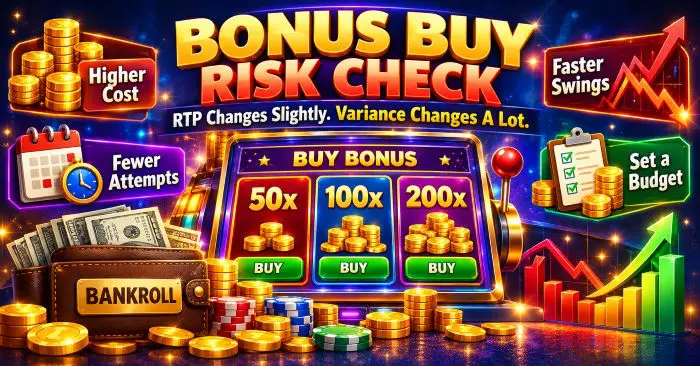
The First time I clicked “buy” on a slot machine, I thought I was being smart. Why would I spend 200 dead spins waiting for 4 scatter symbols to appear when I could spend 100x my stake and instantly enter the free spins round? Within 90 seconds, the bonus paid 14x, and I had lost 86 units quicker than it takes to boil water. That moment taught me more about how to view the bonus buy function than any review.
So what is a bonus buy feature in slot machines?
A bonus buy (or “feature buy”, or simply “BuyBonus” in the menu of some providers) allows you to skip the base game and instantly pay a fixed price to enter the bonus round. As opposed to waiting for the scatter symbols to land randomly and thus triggering the bonus round, the bonus buy function ensures that you receive immediate access to the bonus round. The fixed price is always expressed as a multiple of your current stake, e.g., a 100x bonus buy at a $1 bet costs $100 and a 100x bonus buy at a $0.20 bet costs $20. Most of the time the actual bonus round remains the same regardless of whether you purchase or wait to be triggered naturally. All of these types of features include free spins with multipliers, sticky wilds, expanding wilds, upgrade of symbols, hold & win respin, cash collect features, etc… Whatever type of feature your favorite game has, the bonus buy gives you instant access to it.
Bonus buy vs. Feature buy is simply a matter of nomenclature. While developers such as Pragmatic Play, Hacksaw Gaming, Nolimit City, Relax Gaming, and Push Gaming refer to this feature slightly differently, the basic premise is the same. Another important fact to know is that availability of this feature may depend upon where you play. For example, there are a few jurisdictions, notably the UK government, that prohibit the bonus buy feature in all online slots; therefore, the same game may offer the bonus buy feature in one jurisdiction and not in another.
How does bonus buy function: cost, triggering bonus round, entry
Many gamers miss this section. The cost of the bonus buy is not random. Game developers determine this cost based on how often the bonus round triggers naturally and how much, on average, the bonus round pays, and then charge a premium sufficient to yield the game’s announced RTP over a long period of time. Therefore, if a developer estimates that the bonus round occurs approximately every 250 spins and pays on average around 95x, then charging customers around 100x seems rational. This is why we find that developers tend to cluster pricing in similar ranges.
Is bonus buy better than natural play in terms of return to player (RTP)?
If a developer releases a slot machine with a base RTP of 96.0% and an RTP for the bonus buy feature of 96.6% , then theoretically, you will reduce your expected losses from 4x to 3.4x on a 100x buy. Thus, the potential increase in RTP is real; however, it represents only 0.6x of your bet size per buy. In addition, one single bonus round may vary by as much as 60x to 80x from its theoretical average.

The advantage provided by RTP is essentially meaningless relative to the variance that you are now exposed to. Also, keep in mind that many gaming operators configure games at lower RTP rates than those that are available directly from the software developers. For example, the same title may be available at RTP rates of 96.5%, 95.5%, and 94.5%. Unless you read RTP values directly from your game’s information panel at your gaming operator’s website (and not from a review site), then RTP comparisons between the base game RTP and the bonus buy RTP are essentially meaningless.
Why can bonus buys create bankroll dangers?
While the math behind bonus buys is certainly fair – i.e., a house edge of a few percentage points per buy (same as spinning), the danger lies in how three aspects of the buy button influence our behavior. First, it eliminates our perception of time. A base game session at $1 spins may burn $100 in an hour. A 100x buy burns that amount in one click, and the bonus round plays out within a couple of minutes. Our brains continue to believe that we’ve only made “One go,” so we fail to recognize that we’re spending money. Second, it increases our effective wagered amounts without us seeing the increase reflected in the betting amount displayed on screen. We still see $1 bets; we’re not wagering $1.
Third, the resulting payouts are skewed. Most bonus buy slots produce median payouts from individual buys that are significantly less than the cost of the buy, and although rare large payouts skew the averages upwards (to around RTP), most buys are losing purchases with an occasional large payout that keeps the average close to RTP. If you only have enough money for five buys and happen to miss all five large payouts, you’ll likely leave with your bankroll reduced by 50-70% having done absolutely nothing wrong.
Why do swings from bonus buys feel like such extreme swings
In theory, no – but in practice yes – even though the math remains exactly the same as in normal play. Variance refers to how dispersed results are. By purchasing a buy, you eliminate all low-volatility base game spins and retain only those parts of the game with high volatility (i.e., variance). Generally speaking, variance per unit spent in bonus buy games is greater than variance experienced during normal play; swings occur faster. Here’s an analogy to help illustrate this concept. Imagine Two players who both bring $500 to a 100x buy game where wagers are placed at $1. Player A plays normally by spinning his way through his bankroll and receives approximately 500 spins, along with two or three natural bonuses and some additional smaller wins throughout his session.
Player b spends his entire bankroll on five consecutive buys (approximately). Player a’s session will almost always conclude somewhere within a relatively small range of a moderate net loss. Player B’s session concludes anywhere from effectively zero net gain/losses up to multiples of his initial bankroll, with “effectively zero” being far more probable than depicted in highlights on streaming sites.
Bankroll and loss limit for bonus buys
I approach my thinking in terms of “number of buys” rather than dollars. Twenty buys is a reasonable minimum before you’d expect to see evidence of the long-run average emerging in high volatility games; Ten buys represent a coin toss as to whether you see a large payout or not; five buys is simply One lotteries’ ticket divided into installments. Therefore how many bonus buys should you attempt per session? Determine how much you wish to risk and work backward from that figure; choose a stake low enough to provide you with a reasonably large number of attempts. Using $200 as an example bankroll; Twenty buys at $0.10 per buy at a $100x buy rate provides much greater flexibility than attempting Two buys at $1 per buy.
My checklist prior to beginning a session includes:
- Determine your session bankroll in dollars and consider it already gone.
- Calculate how many buys you can afford (divide your session bankroll by your desired bet); if your answer is less than fifteen or twenty, decrease your bet.
- Determine your stop-loss (your entire bankroll) and win limit (typically double your bankroll); exit halfway through.
- Verify that you have checked your game’s RTP for the bonus buy feature via the game’s information panel at that casino.
- Choose your number of buys beforehand; avoid adding “just One more” after you complete your last buy.
The win-limit will matter more than you realize as well. A huge hit in the First few buys of a session feels like house money; it is simple to fund your entire session back into action at an increased stake after receiving such a huge hit.
When should you consider buying a bonus round
As mentioned earlier, there are valid reasons for buying a bonus round. If you only have limited time and want to experience a particular game’s free spins feature (as opposed to grinding for three hours through the base game), buying at an affordable stake will allow you to test the waters without wasting too much time or money. Similarly, if you want to learn about a new game’s free spins feature before risking any serious money, one or two low-stake bonus buys should provide an adequate representation of how that feature operates. Additionally, if the casino operating RTP for your chosen game is slightly higher than the RTP offered by the game developer, a disciplined gambler with a sufficiently sized bankroll for variance risks nothing more than spinning themselves.
This logic breaks down entirely when the price tag associated with buying a bonus round becomes a significant portion of your total bankroll. This logic also fails when you’re utilizing bonus buy as an emotional crutch: after experiencing a loss; due to boredom; or because you’ve seen someone else hit 5k times their stake.
Streaming sites often show only highlights
Streamers typically operate with
sponsorship funding; therefore, they display highlights of large winning combinations only and show them out of sequence. Therefore, what you see on social media platforms is merely representative of only one side of the distribution curve – not representative of all possible outcomes.
Bonus buy vs. Ante bet vs. Feature drop
All three terms are commonly interchanged incorrectly; they represent distinct concepts. A bonus buy charges a One-time premium for instant entry into a selected game’s bonus round(s). An ante bet adds a premium (typically around 25%) onto each spin’s cost in order to increase the frequency with which free spins are triggered naturally on Pragmatic play games like Gates of Olympus and Sweet Bonanza. You are still playing through the base game; you’re simply paying extra for better scatter odds. Ante-bet typically falls somewhere between natural-play and buying in regards to how rapidly your bankroll decreases.
Some games disable the buy option when playing with an ante bet enabled
Before making either type of bet ensure that you understand which option is currently enabled in your selected game.
Recommended bonus buy slots for different risk levels
I am not going to rank slots based upon their RTP because RTP can differ greatly depending upon the casino where you play, and what constitutes “the best” will depend on what level of pain you can tolerate. Rather, I will describe some popular titles grouped together based upon how they tend to perform. At one end of the spectrum are Big Bass Bonanza and Fruit Party by Pragmatic Play, where bonus rounds pay something somewhat larger more frequently and generally produce max wins ranging from low thousands up to mid-thousands times your original wager. Although you will still lose money on most buys, losses are less severe and a Twenty-buy session rarely leaves players feeling like they fell off a cliff.
Next on this scale is the Dog House Megaways, which performs similarly until you opt for sticky wilds on your free spins round – this version produces larger but less frequent payouts and appears to be an attractive option for gamblers looking for slightly more aggressive performance. At the other end of this scale are Gates of Olympus and Sweet Bonanza – both are traditional 100x bonus buy slots featuring multiplier-based payouts combined with tumbling reels creating extremely variable payouts; this is why both games are among the most widely utilized for this purpose in online gambling today. Finally, Wanted Dead or Alive by Hacksaw Gaming ranks closer to gates/olympus/Sweet Bonanza due to multiple buy-in options combined with max wins approaching five figures.
For gamblers new to bonus buys, I recommend starting low stakes and over several sessions track results
Once you gain experience with low-stakes bonus buys (and can gauge how far below cost most payouts fall), you will develop your own opinion regarding how much variability exists between games – which will serve as valuable guidance moving forward.
FAQs: Bonus Buy RTP, Cost, and Bankroll Risk
Is there really such a thing as a “Bonus Buy” that increases RTP?
Sometimes yes, but usually not. I think it’s safe to say you’ll have to check the game information at your casino because they can run several different RTP levels for the same game. Some may even be worse.
Will a Bonus Buy definitely produce a win?
No. All it will do is get you into the Bonus Round. Even if you’ve purchased a Bonus, you could end up getting paid less than what you’ve spent (and this happens most of the time).
Are there cases where losing money occurs when buying into a Bonus Round?
Yes, and quite often. Most of the time, the payout from a Bonus is going to be a smaller percentage of what you spend to buy-in. This is why the overall average payout is kept artificially high due to the occasional big winner.
How come do Bonus Buys eat through my bankroll so fast?
Each time you make a buy-in, you’re essentially spending as much or more money than would normally be spent over an extended period of multiple spins.